


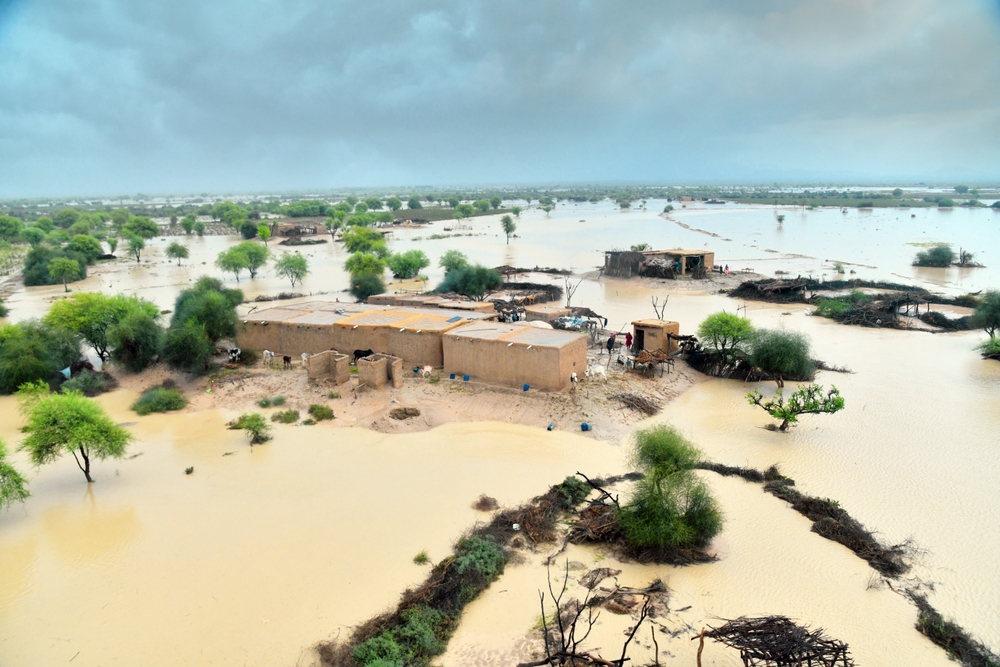
Rescuers and relatives waded through knee-deep water, searching for the body of one-year-old Zara. Flash floods had swept her away while the bodies of her parents and three siblings had been recovered days earlier.
“We suddenly saw a lot of water. I climbed to the roof and urged them to join me,” said Arshad, Zara’s grandfather, showing the dirt road where the current took his family in the village of Sambrial, northern Punjab.
His family tried to reach him but arrived too late. The powerful current washed all six of them away.
Every year, Pakistan’s monsoon season brings deadly floods. This year, it began in late June. Within three months, more than 1,000 people had died, and at least 6.9 million were affected, according to the United Nations Office for the Coordination of Humanitarian Affairs.
The South Asian nation struggles with the devastating effects of climate change despite contributing just 1% of global greenhouse gas emissions. Traveling from northern mountains to southern plains revealed that each province suffers differently. Yet one factor is consistent: the poorest face the greatest loss. Families lost homes, livelihoods, and loved ones, fully aware that the next monsoon could repeat the tragedy.
Lakebursts and flash floods
Monsoon floods began in the north, with global warming manifesting sharply in Gilgit-Baltistan. Among the Himalayas, Karakoram, and Hindu Kush, more than 7,000 glaciers melt faster due to rising temperatures. Meltwater collects in glacial lakes, which can burst suddenly, putting thousands of villages at risk.
This summer, hundreds of homes were destroyed, and landslides damaged roads. These glacial lake outbursts remain hard to predict in remote areas with poor mobile signals. Pakistan and the World Bank are trying to improve early warning systems, yet mountainous terrain often hinders their effectiveness.
Communities provide a lifeline. Shepherd Wasit Khan woke to rushing water, carrying ice and debris. He climbed to a better signal and warned as many villagers as possible. “I told everyone to leave their belongings, take children and elderly, and get away,” he said. His warnings saved dozens.
In the north-western province of Khyber Pakhtunkhwa, danger took another form. In Gadoon, hundreds of villagers dug through piles of rocks with bare hands after a sudden cloudburst triggered flash floods. Heavy, localized rainfall washed away homes and caused landslides. Neighbours rushed to help, but excavators remained trapped on flooded roads blocked by rocks. “Nothing will happen until the machines arrive,” a villager said. Then silence fell. Rescuers pulled the mud-soaked bodies of two children from the rubble.
Similar scenes unfolded across the province. Uprooted trees and destroyed infrastructure delayed rescue efforts. A helicopter carrying aid crashed in bad weather, killing the crew.
Building on Pakistan’s floodplains
Millions live near rivers and streams, despite the River Protection Act prohibiting construction within 61 meters of waterways. Many cannot afford to move, and illegal construction worsens flood risks. Climate scientist Fahad Saeed blamed local corruption and government inaction. Pointing to a half-built four-storey building next to a stream, he said floods had already killed a child there this summer. “Just a few kilometres from parliament and still such things happen,” he said. “The government must act as a watchdog.”
Former climate minister Senator Sherry Rehman called this corruption, describing it as officials turning a blind eye to unsafe construction.
The country’s breadbasket submerged
By late August, floods submerged 4,500 villages in Punjab, devastating Pakistan’s agricultural heartland. Three rivers—the Sutlej, Ravi, and Chenab—flooded simultaneously, prompting the largest rescue operation in decades. “It was the most important anomaly,” said Syed Muhammad Tayyab Shah, chief risk officer at the National Disaster Management Authority.
In Lahore, the impact varied sharply. Wealthy gated communities along the Ravi river faced flooding, forcing residents to evacuate. Some residents expected developers to drain water quickly. Meanwhile, poorer neighbourhoods faced crushing floods. Rescue teams repeatedly saved people who returned to salvage belongings.
In relief camps, women and children suffered the heat and disease. Sumera, weeks from giving birth, clutched her toddler while waiting for medical aid. Ali Ahmad balanced a rescued kitten on his shoulder, one of the few with a mattress to sleep on. By the end of the monsoon, floods displaced over 2.7 million people and damaged more than one million hectares of farmland.
In Multan, tents lined dirt roads as the humanitarian crisis grew. Rural access to healthcare, already limited, became unbearable. Two nine-month-pregnant women could only drink brown water, warned by doctors that they were dehydrated.
The search for solutions
Some residents adopt innovative solutions. Architect Yasmeen Lari designed “climate-resilient houses” in dozens of villages. Near Hyderabad, women showed circular huts built on wooden stilts to protect belongings from floods. Lari said these designs allow roofs to withstand storms and enable villagers to rebuild quickly using bamboo and lime concrete.
She warned that entire villages on stilts would be too costly. “It’s not about saving buildings; it’s about saving lives,” she said.
Climate scientists and officials warn that monsoon seasons will grow more intense every year. Shah at the NDMA said, “Every year, there will be a new surprise for us.” For communities returning to flood-prone homes, the reality remains stark: “I have nowhere else to go.”
