


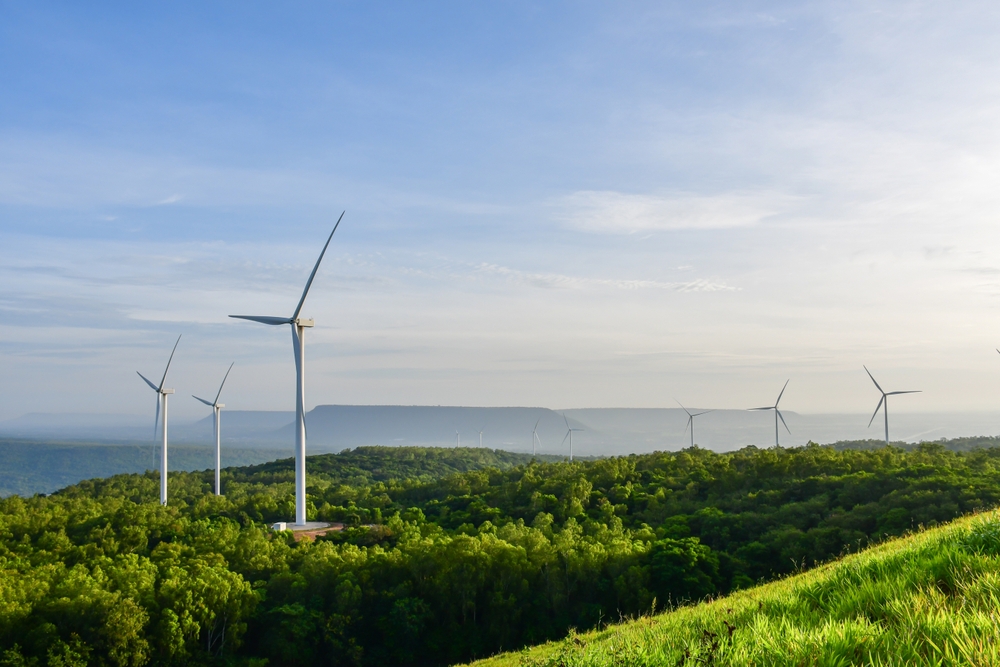
On the outskirts of Figueruelas, a lone, massive wind turbine turns slowly, casting long shadows over the town. It symbolizes the region’s reliance on renewable electricity. Aragón, in north-eastern Spain, hosts many of the country’s wind and solar farms, shaping the area as a hub for green energy.
Recently, Figueruelas gained further prominence with the announcement of a massive electric vehicle battery factory. Chinese company CATL and the Netherlands-based Stellantis are investing a combined €4 billion. Yao Jing, China’s ambassador in Spain, called it “one of the biggest Chinese investments Europe has ever seen.”
Luis Bertol Moreno, the town’s mayor, says the location made perfect sense. “We’re in Aragón, where the wind blows all year, and there are abundant hours of sunshine. The area is surrounded by turbines and solar panels,” he says. “Those energy sources will power the new factory. That was the key reason for building here.”
Vindication for Spain’s renewable model
The factory highlights Spain’s commitment to renewable electricity. In 2017, renewables accounted for just a third of the country’s electricity. Last year, they provided 57% of total output. The government aims to raise that figure to 81% by 2030.
Earlier this year, Prime Minister Pedro Sánchez summarized the government’s approach with a message aimed at US pro-fossil policies: “Green, baby, green.” He highlighted the economic and environmental benefits of renewable energy.
Blackout casts doubt on all-in renewable strategy
Recent events have challenged Spain’s renewable ambitions. On 28 April, a blackout plunged homes, businesses, government offices, transport, schools, and universities across Spain and Portugal into darkness for several hours.
The government could not fully explain the outage, sparking a heated political debate over the country’s energy mix. Conservative opposition leader Alberto Núñez Feijóo called the government “fanatic” for overcommitting to renewables, implying the blackout might have resulted from over-reliance on green energy.
Feijóo pointed to a record 61.5% solar contribution to Spain’s electricity just a week before the blackout as evidence for a needed rethink.
Authorities deny renewables caused the outage
Both the government and national grid operator Red Eléctrica rejected the claims. Concha Sánchez, head of operations at Red Eléctrica, said the system has operated at higher renewable rates before without security issues. “It wasn’t the rate of renewables at that moment,” she said.
She explained that the blackout resulted from multiple factors, including an “unknown event” in the system that caused unusual voltage oscillations. Authorities continue to investigate and await reports to determine the precise cause. They have repeatedly ruled out a cyber-attack.
Since April, Spain has relied more on natural gas, signaling the country may be at a crossroads in its energy policy.
Nuclear energy debate intensifies
Spain’s nuclear sector, currently supplying around 20% of electricity, has voiced concern over government plans to close five nuclear plants between 2027 and 2035. Many European countries are undergoing a nuclear revival, making Spain an outlier.
The Almaraz plant in south-west Spain, scheduled to shut down first, requested a three-year extension to 2030, now under consideration. Ignacio Araluce, president of Foro Nuclear, says Spain is unique in closing operating nuclear plants. He argues nuclear energy stabilizes the grid while supporting renewable expansion.
Araluce emphasizes the need for a mixed energy strategy. “Renewables need sunlight and wind, and they cannot operate 24/7,” he says. Nuclear energy produces CO2-free power continuously, filling gaps when renewables cannot.
Far-right Vox has also criticized the planned closures, calling nuclear power a “crucial source of stability,” especially after the April blackout.
Challenges remain in storage and grid integration
Concha Sánchez admits Spain’s electricity model needs improvement. The Iberian Peninsula remains relatively isolated from the European grid. She also highlights storage as a key challenge. “We need to promote storage installation,” she says, adding that Spain has lagged behind in this area despite progress in renewable deployment.
Political uncertainty further complicates Spain’s energy future. The Socialist-led coalition faces corruption scandals and a weakened parliamentary majority, raising the likelihood of a snap election. Polls suggest a right-wing government could take power, potentially scaling back renewable investment in favor of traditional energy sources.
Figueruelas benefits from green transition
Despite political debates, Spain continues its renewable transition. In Figueruelas, this brings both clean energy and economic growth. The town of just 1,000 residents will see 2,000 Chinese workers arrive to construct the new battery plant. Once operational, the facility could generate up to 35,000 indirect jobs.
Local resident Manuel Martín says the factory revitalizes the area. “These investments boost the local economy, construction, and hospitality sectors,” he says. “And the energy is free—it only depends on the sun and wind.”
