


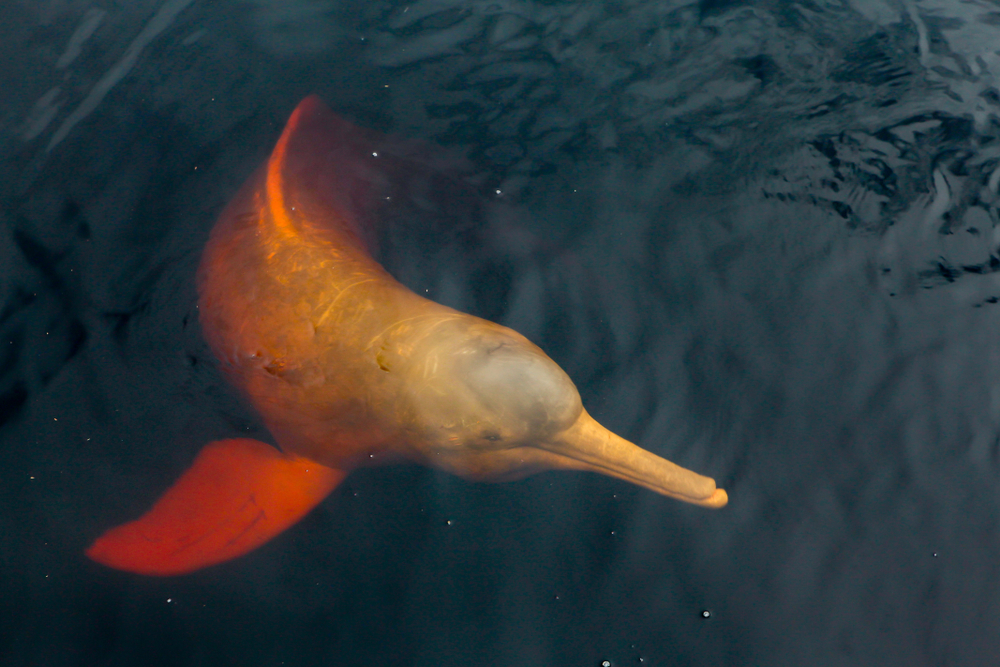
A rare encounter beneath the surface
As the sun sank behind the trees in 2023, photographer Thomas Peschak slipped into the black waters of Brazil’s Rio Negro. He waited quietly with his camera ready, hoping to catch a thief in the act. Fishermen nearby threw their nets into the river, unaware that a pink shadow was approaching. From the depths, a sleek Amazonian river dolphin appeared. Peschak held his breath and started shooting. The dolphin moved swiftly, poking holes in the net and stealing a catfish before vanishing into the dark. “They are very agile and move underwater with incredible skill,” Peschak says. “They are great thieves!”
He knew he had captured a scene few had ever witnessed. The dolphins have learned to connect the sounds of fishing boats and nets with an easy meal. Peschak became the first photographer to document this behaviour underwater. The challenge was immense. Visibility was poor, and the locations of the animals were uncertain. Yet, with more than 20 years of marine photography experience, he drew on his knowledge of ocean work. “In most Amazon rivers, no one has ever dived to take photos before,” he says. “You go underwater and figure it out yourself.” His images later earned him the Photojournalist Story Award at the 2024 Wildlife Photographer of the Year competition.
The mysterious pink giants of the Amazon
Locals call them boto in Portuguese and bufeo in Spanish. These pink river dolphins are striking with their rosy skin, long slender snouts, and rounded heads. They are the largest freshwater dolphins in the world, reaching 2.5 metres in length and weighing up to 200 kilograms. Four types inhabit the Amazon basin, and all face endangerment. Their populations have fallen due to hunting, entanglement in nets, pollution, and drought.
Like other dolphins, they rely on echolocation, using clicks and echoes to sense their surroundings. The bump on their heads, known as the “melon,” helps them amplify sound and navigate the murky water. It creates a mental map of the river’s obstacles and prey.
Legends, fears, and human conflict
The dolphins’ odd looks and clever behaviour have inspired countless legends. Many Indigenous groups believe the boto live in underwater cities hidden deep in the rivers. Others claim the dolphins can transform into humans. At night, they supposedly take the form of pale men who seduce and kidnap young women. This mystical reputation, along with their habit of stealing fish, has caused both awe and resentment.
“Some fishermen see them as rivals,” Peschak says. “They damage gear and take fish, so they’re often viewed as enemies.” He documented these tensions during a two-year National Geographic expedition across the Amazon River Basin. He joined scientists travelling from the Andes to the Atlantic, witnessing threats like accidental entanglements and violent retaliation. Even without direct attacks, dolphins risk injury from boat propellers or drowning in nets.
The deadly danger of fishing nets
“The nets are our main concern,” says marine biologist Fernando Trujillo, who has studied South American river dolphins for over 30 years. He estimates that in a small area of Colombia alone, more than 700 dolphins die each year from nets. Trujillo, a member of the Colombian Academy of Sciences, founded the Omacha Foundation in 1993 to protect Amazonian wildlife. Together with other organisations, the foundation formed the South American River Dolphin Initiative (SARDI). Since 2017, this group has surveyed more than 90,000 miles of rivers across seven countries.
Trujillo’s team collaborates with local fishermen to conduct dolphin health assessments in Ecuador, Peru, Colombia, and Brazil. Within 15 minutes, they catch, examine, and release each animal. They measure weight and size, take blood samples, perform ultrasounds, and attach GPS trackers.
Sentinels of the rivers
“The dolphins are the sentinels of the rivers,” Trujillo says. Many show signs of contamination from mercury and microplastics. Illegal gold mining and forest fires have worsened the situation. Some dolphins even suffer lung problems from smoke in the burning rainforest. These health issues reveal the state of the ecosystem. When the dolphins suffer, so do humans. “They’re like canaries in a coal mine,” Trujillo explains. “If the dolphins are healthy, the river is healthy.”
Climate change and local action
In 2023, a historic drought killed more than 130 pink river dolphins in Brazil. Many became trapped in shallow, overheated waters above 40 degrees Celsius. To protect them, Trujillo’s foundation now trains local fishermen. They learn how to rescue trapped or entangled dolphins and help during droughts. This collaboration is slowly changing attitudes. “Now fishermen say, ‘Dolphins are like us. They share the same river and problems,’” Trujillo notes.
Locals also receive training as dolphin-watching guides, offering a sustainable income alternative. They learn to keep safe distances and share Indigenous stories about the animals. Romani Peña Gómez, a Tikuna guide from Colombia, remembers songs and dances about dolphins from his childhood. “For us, the dolphins are the joy of the river,” he says. “Protecting them means protecting our environment. They are the protectors of the rivers.”
Science and cooperation offer hope
In Brazil, researchers like biologist Mariana Paschoalini Frias from WWF are testing new ways to prevent dolphin deaths. Her team uses “pingers,” small sound devices attached to nets, to deter dolphins. “Often the fish are the only food these families have,” Frias explains. “We want both dolphins and fishermen to benefit.” In the Tapajós River, pingers have reduced net damage by about 40 percent, increasing both catches and income.
Fisherman Elias Correia da Silva confirms the change. “Before, we hated the dolphins,” he admits. “Now we try to live in harmony. We can all share the river.” Frias believes that community cooperation is vital for the dolphins’ survival. “A sustainable future for the Amazon must come from its people,” she says.
A call to protect the Amazon’s heart
For Thomas Peschak, the pink river dolphins symbolise the soul of the Amazon. “They are a fascinating flagship species,” he says. “They represent the most diverse freshwater system on Earth. Their story shows how fragile and magnificent the Amazon’s biodiversity truly is.”
