


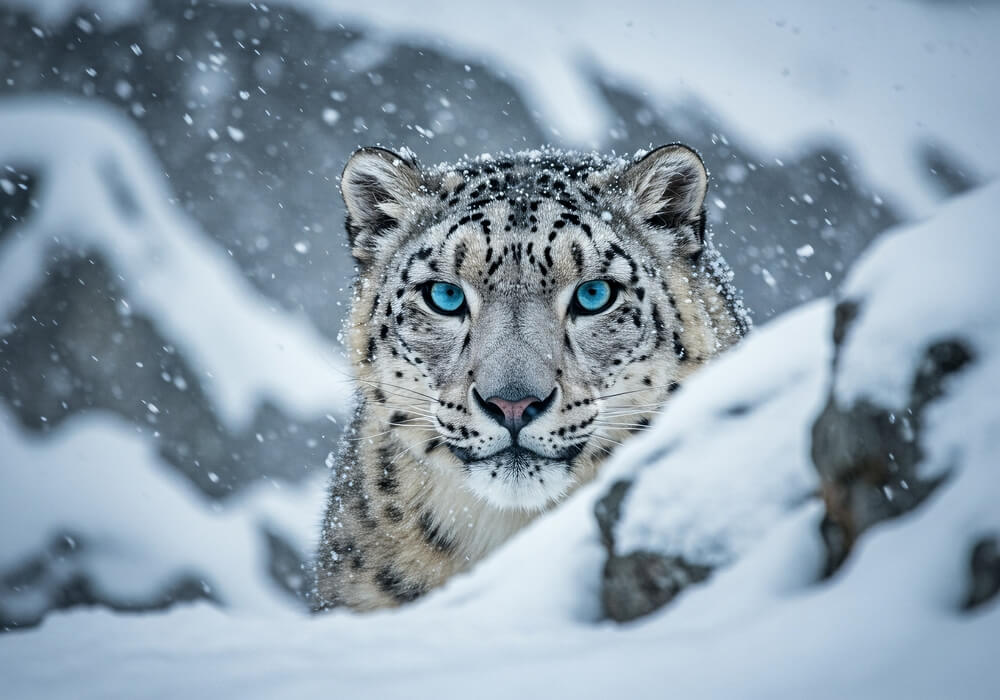
In the frozen valleys of Uzbekistan’s mountains, Michaela Strachan and India Latham search for traces of the world’s most elusive cat.
The temperature hovered around -6°C (21°F). Our hands barely worked. We had already scanned three memory cards, watching hundreds of clips. Bears, ibex, and a porcupine appeared in the darkness. Every sighting thrilled us, but the snow leopard remained the prize.
Then it appeared. The team erupted in cheer. A magnificent snow leopard, the so-called “ghost of the mountain,” prowled across the frame. Its long tail swayed as it moved confidently. Finally, we confirmed it lived in these peaks. Alive. Enduring.
The silent and solitary predator
Snow leopards remain invisible to most humans. They inhabit the vast Tian Shan range, which stretches over 2,500 km (1,550 miles) across Central Asia to China. Experts estimate more than 1,000 snow leopards exist there, but only a few hundred roam western Uzbekistan.
Our crew spent seven days in Uzbekistan, filming in a Soviet-era nature reserve. The search aimed to capture proof of the world’s most elusive feline.
We began our journey in Samarkand, a city renowned on the Silk Road. Our guide, Inom Isroilov, introduced us to its architecture and the subtle presence of snow leopards in local symbolism. The animal appears at the center of the city’s emblem, painted on souvenirs and carved in calligraphy across Registan Square.
“Snow leopards are part of our identity,” Isroilov explained. “They symbolize protection. Now, we must protect them.”
Conservation status and threats
In 2017, the International Union for Conservation of Nature reclassified snow leopards as “vulnerable.” Conservation efforts improved data on their populations, but scientists warn of continuing threats. Habitat loss, poaching, prey decline, and climate change still endanger the species.
We drove south from Samarkand. Arid plains gave way to rocky hills as dust rose under thinning air. Villages and roadside fruit huts disappeared. Our Soviet-era Lada rattled over rough terrain. Its durability mirrored the rugged, unchanged landscape we entered, largely preserved since the Soviet era.
We were headed to Gissar State Nature Reserve, Uzbekistan’s largest protected area. Covering 810 sq km (313 sq miles), it rivals the size of New York City. Established in 1985 as a “zapovednik,” it followed Soviet principles of strict ecosystem protection. Settlements, grazing, and industry were restricted. Only rangers and researchers had access. These reserves later influenced UNESCO’s biosphere frameworks.
The reserve borders Tajikistan, which added a security dimension. Landmines marked parts of the border after regional conflict. While cities expanded elsewhere, these mountains stayed largely untouched.
Preserving nature through strict protection
“The Gissar reserve had a positive ecological impact,” said Elena Bykova from the Uzbek Academy of Sciences. “Despite imperfect management, human pressure stayed minimal. The ecosystems remain almost untouched.”
Minefields disrupted animal migration, and bears and ibex occasionally triggered explosives. Yet strict access rules prevented development, intensive grazing, and settlement, preserving the landscape better than other regions. Gissar hosts over 270 animal species and more than 1,200 plant types, many rare or endangered.
Access requires special permits. Since 2016, Uzbekistan welcomed tourists, but core areas remain controlled.
Our team prepared to trek with local rangers, hoping for a snow leopard sighting. The mountains challenged us with bitter wind, thin air, and rugged trails. Snow leopards thrive in this altitude, but their elusive nature made sightings rare.
Tracking the ghost of the mountain
Rangers, led by director Kakhramon Kamolovich, installed over 70 camera traps across the peaks. Snow leopards roam twelve countries, often through politically sensitive regions. Protecting them requires international cooperation. In 2024, Uzbekistan coordinated a cross-border agreement to monitor and conserve snow leopards, strengthening global collaboration.
We hiked with Mariya Gritsina from the Institute of Zoology in Uzbekistan. She tracks snow leopards’ movements and habitats. “Even if you devote your life to them,” she said, “you may see only one.” Scientists still struggle to cover the full territory.
Snow leopards mostly appear at dawn or dusk. Globally, estimates range from 4,000 to 6,500 individuals. Scientists hope new survey methods will provide a clearer picture of populations.
We tracked fox prints, ibex droppings, and lynx paw marks—signs of a thriving ecosystem. On a high ridge, a ranger shouted. We discovered snow leopard scat. It confirmed that a predator had been here recently, surveying the mountains below.
Balancing protection and community needs
Local communities sometimes resent strict reserve rules. Prohibitions limited land use, leading to poaching and illegal grazing. Bykova explained that protection works best when paired with community support.
Long-term monitoring shows snow leopard numbers rising steadily since the 1980s. Gissar now hosts 61 individuals. Limited development preserves habitats, but conservation must extend beyond reserve boundaries. A third of Uzbekistan’s snow leopard terrain lies outside protected areas, where grazing and poaching continue.
“They’re beautiful, scary, but beautiful,” said goat herder Askar Khasanovich Shermatov. “Numbers grow yearly, and rangers protect prey. My herds remain safe if there is enough food.”
Gritsina develops community plans to manage attacks and compensate herders. Practical, locally tailored solutions build trust and reduce conflict.
Moving toward integrated conservation
New reserves in Uzbekistan balance protected zones with sustainable-use areas. “We are far from perfect,” Bykova admitted, “but understanding grows that biodiversity requires careful management alongside people.”
Threats in Gissar include prey poaching, habitat degradation, infrastructure, and climate change. Geography complicates protection. A snow leopard safeguarded in one country may face danger in a neighboring state. Harmonizing laws and sharing research is vital for cross-border protection.
Cooperation is evident. Rangers work under difficult conditions. Scientists share data internationally. Communities adapt to coexist with wildlife.
We did not see a snow leopard in the wild. Yet data proves they roam here. Conservation builds knowledge and protects landscapes that remain vast, silent, and largely untouched—an increasingly rare treasure.
