


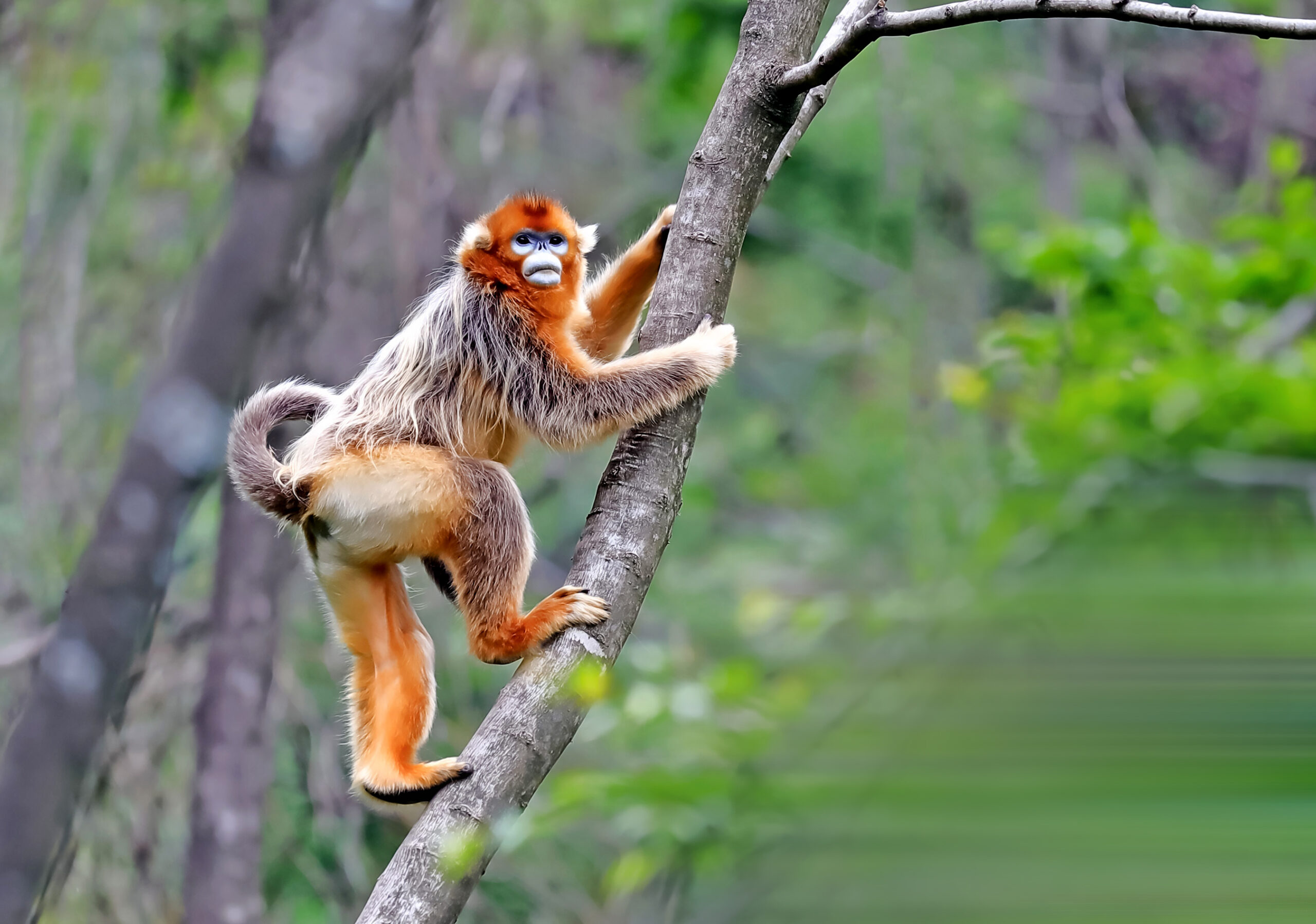
A species close to extinction
Until the 1980s hunters roamed the Shennongjia mountains in central China searching for monkey meat and fur. Poor farmers cleared huge areas of forest, and as the trees vanished, the golden snub-nosed monkey population collapsed. Fewer than 500 remained in the wild. This was the reality when young graduate Yang Jingyuan arrived in 1991. He was just in his early twenties.
“The monkeys’ home was being destroyed by logging, so their numbers were falling fast,” he recalled. “Now the forest is protected, and the population is growing again.” Today Professor Yang directs the Shennongjia National Park Scientific Research Institute. Few people know these monkeys as well as he does.
A lifetime dedicated to protection
Now 55, Professor Yang has devoted his career to studying and protecting this endangered subspecies. They exist only in Hubei’s mountains, and he regularly ventures into the forest to observe them. I asked if he could really understand their calls.
“Yes,” he explained. “Yeeee means the area is safe. Wu-ka warns of danger. Be careful.” As he spoke, monkeys descended from the trees, touching us and curiously observing. We sat on the ground to relax them. Yang described their complex social structure while baby monkeys climbed into our laps.
A family group has one male, three to five females, and their children. Several families unite to form a larger band of more than 100 animals. Bachelor males form their own groups, often standing guard. Females sometimes mate outside their groups, which sparks conflicts. Fights break out when males take over families or when bands clash over territory.
Six-year-old females instinctively leave their families to avoid inbreeding. The animals live around 24 years. At life’s end, they withdraw alone to die in seclusion. Rangers say no one has ever found their bodies.
Struggles of the past
The monkeys now range across 400 square kilometres, a remarkable change. The national park was created in 1982, but real progress took decades. Ranger Fang Jixi, 49, grew up in the region and remembers poverty driving destruction.
“People were very poor, and hunger was real. No one thought about protecting wild animals,” he said. “Even after logging was banned, some still cut trees illegally to survive. Hunting continued too. Only after years of education did awareness spread.”
Farmers were eventually brought in as protectors, not destroyers. “Scientists told us we could work with them,” Fang recalled. “We could get jobs helping the animals.” He now patrols the hills, tracking poachers and locating monkeys for research. The task is tough. Monkeys can cross treetops in minutes, while humans need hours to catch up.
Winning trust of the monkeys
The breakthrough came in 2005, when Professor Yang formed a specialist team. They spent a year approaching a particular group of monkeys. “At first, they fled when they saw us,” Yang said. Slowly, the distance shrank from 800 metres to direct contact.
“I was thrilled when they finally trusted us. We could spend every day together,” he said. Old photos show bare hills with just 60% tree cover. Now drones reveal a forest canopy at about 96%.
The restored landscape attracts millions of tourists, but strict rules protect the monkeys. Visitors cannot enter designated protection zones. Only approved staff may approach the animals.
Human changes for wildlife survival
We followed a rugged mountain path in one of these restricted zones. Cameras and transmitters monitored not only monkeys but bears, boar and other species. From a high viewpoint, rangers pointed out a valley where farmers once lived. Families had been relocated to preserve the ecosystem.
One former resident told us he felt relief after moving. With government support, he and his family opened a guesthouse. Life was now easier and more hopeful.
Yet challenges remain. Golden snub-nosed monkeys reproduce slowly. Females give birth only every two years, and not all infants survive. Still, the population has tripled. From 500 individuals, it has reached more than 1,600.
A hopeful future
Yang believes the number will pass 2,000 within ten years. “I am optimistic,” he said. “The monkeys’ home is well protected. They have food and water. Their numbers are rising.”
