


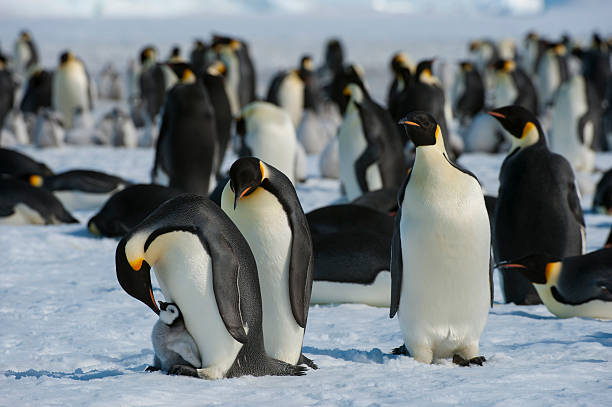
Scientists warn that a natural yearly event may now threaten the survival of Emperor penguins. During their annual moult, the birds shed all their feathers and grow a new waterproof coat. They must remain on stable floating sea ice while this process takes place. Climate change now transforms Antarctica and removes the ice platforms they desperately need.
Between 2022 and 2024 Antarctic sea ice shrank dramatically. Researchers link this decline largely to global warming. Satellite images now reveal a troubling pattern. Many penguin groups that once appeared clearly on the ice have vanished. Scientists fear that thousands may have frozen to death in the icy waters.
A Shocking Discovery for Researchers
“This was truly an ‘oh my God’ moment,” says Dr Peter Fretwell of the British Antarctic Survey. He has studied Emperor penguins for 20 years. “I immediately saw that this could change everything for Emperor penguins,” he explains. “I began asking whether we still have time to save them.”
The study appeared in the journal Communications Earth & Environment. It documents the consequences of the collapse in Antarctic summer sea ice between 2022 and 2024. International coverage had previously highlighted the historic scale of that ice loss.
The research focuses on West Antarctica, home to 30 to 40 percent of the global Emperor penguin population. The species ranks among the most threatened wildlife on Earth. Every summer the birds travel thousands of kilometres to find stable sea ice. There they endure what scientists call a “catastrophic moult.”
The Most Dangerous Period in a Penguin’s Life
Scientists once knew little about the 30 to 40 day moulting period. Fretwell then identified large brown stains in satellite images taken between 2019 and 2025. These marks turned out to be piles of feathers in Marie Byrd Land.
Emperor penguin feathers provide some of the most complex and effective insulation in the animal kingdom. Wind, saltwater and ice damage them over time. The birds therefore replace them completely each year. “The process demands enormous energy and birds lose up to 50 percent of their body mass,” says Fretwell.
During the moult the penguins lack their waterproof protection. They cannot enter the ocean to feed. “This is probably the most dangerous time for adult Emperor penguins,” Fretwell explains. If they fall into the water, they will likely die.
Sea Ice Collapse Changes Everything
In 2019, 2020 and 2021 sea ice remained relatively stable. Satellite images showed clear feather piles and numerous penguin groups. In 2022 Antarctic summer sea ice dropped sharply across large regions. The area fell from an average of 2.8 million square kilometres to a record low of 1.79 million square kilometres in 2023.
The downward trend continued until 2025. That year brought a modest recovery of sea ice in West Antarctica. Yet when Fretwell examined the latest satellite images, he found very few birds. “There should have been many penguins there, but I could only identify 25 groups,” he says. Groups range from a few dozen to as many as 1,000 birds.
This year sea ice conditions have not been especially poor. Nevertheless, Fretwell sees only a handful of penguins. He fears that most of the missing birds have died. Some may have moved to East Antarctica to moult. Such relocation would disrupt breeding cycles and cause further population losses.
Adaptation May Offer the Only Hope
Researchers believe long-term survival depends on adaptation. Emperor penguins may need to moult on shallow ice shelves instead of floating sea ice. Fretwell has already observed some groups attempting this shift. However, this strategy may affect feeding routes and breeding behaviour.
He says the findings show how climate change can trigger sudden, dramatic impacts. “We did not just lose a few colonies, and the process was not gradual,” he explains. The experience has affected him deeply. “This is the only scientific work that has truly moved me emotionally,” he says.
Fretwell now plans to compare his results with an upcoming population count in the Ross Sea region. Emperor penguins migrate to and from this area regularly. The new data should clarify how many birds may have died.
He warns that the results could alter predictions about the species’ extinction timeline. “I now ask whether that future is moving closer,” he says. “Could it arrive before the end of the century?”
