


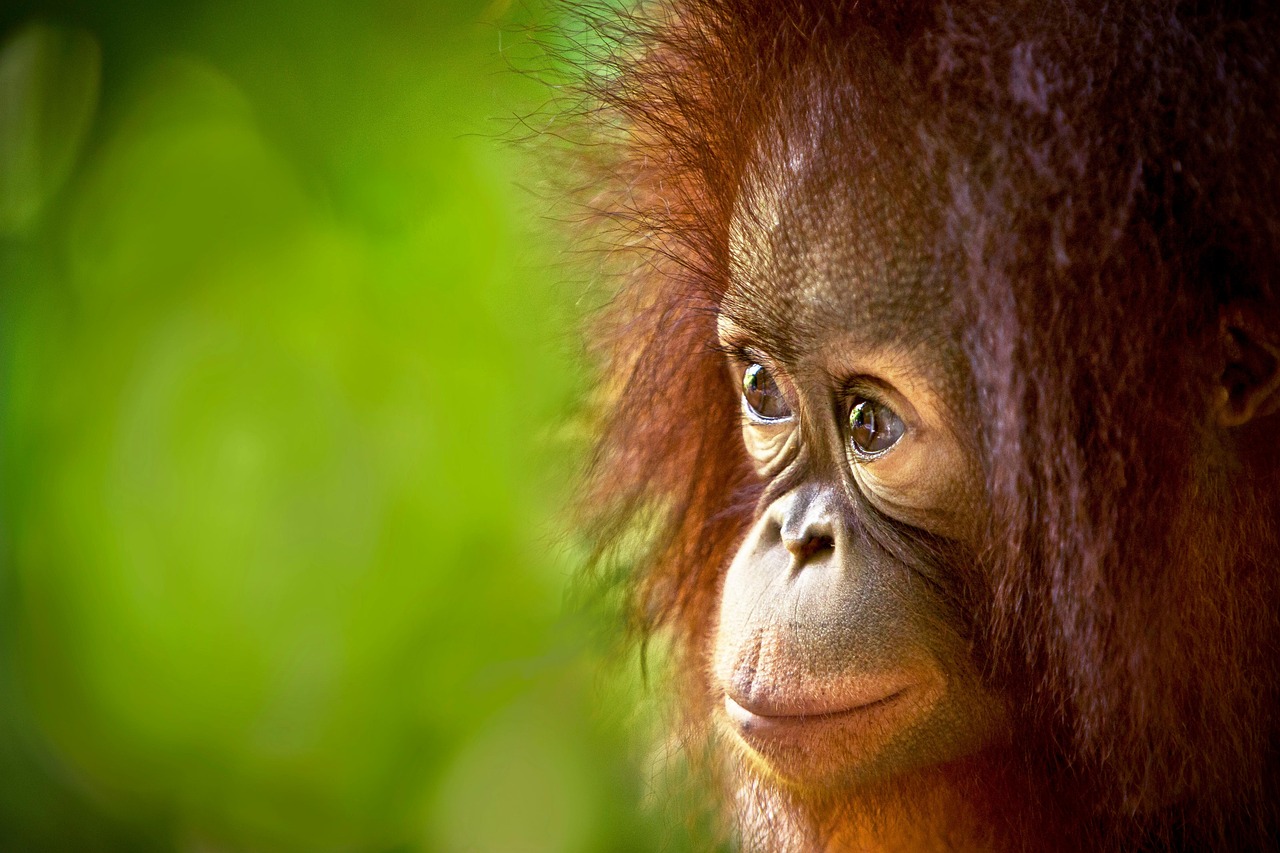
A refuge for endangered great apes
The young orangutans tried to delay bedtime. One grabbed a long leaf through the bars, begging for play. Then came a classic toddler trick: suddenly needing the toilet.
Finally, the youngster climbed onto a wooden jungle gym. The floor was scattered with sticks and scraps of wood. The little ape curled into a hammock and pulled a big leaf over its body as a blanket.
In the wild, orangutans build new nests each night. They weave branches and leaves in the forest canopy. But this was not the wild. It was the site of the world’s largest orangutan rescue organization: the Borneo Orangutan Survival Foundation (BOSF).
Life between cages and islands
The day before, a female orangutan used a palm frond as shelter from the rain. She lived on an artificial island, too tame to release but free of cages.
Nearby, a large male bargained with his keeper. The man wanted him to eat carrots before offering dragon fruit. The orangutan poked a stick toward him as if to say: Give me the fruit now.
The keeper stayed calm. He knew the bluff. Orangutans cannot swim.
They share 97 percent of their DNA with humans. That missing three percent contains surprising honesty.
Borneo’s shrinking rainforest
Many imagine Borneo as endless jungle, full of giant flowers and venomous snakes. In 1984, writer Redmond O’Hanlon described towering trees crowding hillsides down to the rivers.
Back then, three-quarters of the island was rainforest. Today, nearly half is gone. From the air, barges and cleared land dominate the view. Even the airport gleams with a Western café.
Still, Borneo remains a biodiversity hotspot. One Malaysian park holds over 1,000 tree species in 125 acres. A single tree can host 1,000 insect species. The island carries six percent of Earth’s biodiversity and 90 percent of all orangutans.
But palm oil and mining threaten survival. The population fell from 300,000 in 1999 to just 100,000 today. Scientists warn that deforestation could wipe out another quarter by 2032.
The mission to save lives
Since 1991, BOSF has released 533 orangutans. Another 359 remain permanently. They are too tame, injured, or sick for release. Some live in cages, others on man-made islands.
Twenty diseased animals stay in raised cages, each separated for safety. One female slid down a rope with gymnast-like agility. In another cage, Kopral, who lost both arms to electrocution, flipped across his enclosure.
Yet a greater threat looms. Indonesia is building a new capital, Nusantara, only 40 miles from BOSF’s East Kalimantan center. By 2035, the population in Indonesian Borneo could reach 20 million.
Balancing conservation and survival
The government promises a “green forest city,” carbon neutral by 2045. Yet vast construction scars the land. Workers filmed an orangutan crossing a half-built road. Scientists warn such megaprojects always damage wildlife.
Funding also challenges the sanctuary. Caring for one orangutan costs $500 monthly. The average local income is $350. BOSF appeals to foreign donors instead, offering symbolic adoptions for $10 a month.
“We must prevent people from seeing orangutans as competitors,” says trustee Jamartin Sihite.
A slow life in the treetops
Orangutans heal wounds with plants. They craft tools and save their favorites for later. But they remain solitary, unlike gorillas or chimpanzees. They also reproduce painfully slowly.
Females bear a new child only every seven years. That pace leaves the species vulnerable. Some mothers suffer postpartum depression, especially those who lost their own mothers to violence. If they reject their babies, the staff must intervene.
In “jungle school,” technicians teach survival. They show how to climb, forage, and build nests. The apes copy their teachers. Women perform the role better, since deep male voices often scare the orphans.
Graduates move to semi-wild islands to prove independence. “We don’t hug them. We don’t say their name,” says veterinarian Agus Irwanto.
Returning to the wild
If they succeed, the apes receive tracking chips and cages for transport. BOSF releases them in remote forests after a 12-hour journey. Researchers track them for a year, often hiking for days. “The hardest part is your neck from staring up,” says a young scientist.
The sanctuary itself carries orangutan symbolism. Its visitor building resembles the apes, with long wooden “arms” and a dark, hair-like roof.
BOSF also restores forest. Since 2000, the group replanted 5,000 acres with 740 tree species. Local villagers can grow fruit there if they protect the trees. Birds and bats spread more seeds naturally. The apes eat two tons of fruit daily, often purchased from the same farmers.
But coal mining dominates the landscape. Borneo supplies 60 percent of Indonesia’s exports. Illegal mining adds to the destruction. Despite this, BOSF now advises the government on how to reforest land around Nusantara.
Hope in the shadow of development
A night drive to the new capital shows both danger and awe. Dust from trucks hangs in the air. Bulldozers move like metal beasts. Then, out of the chaos, rises a giant eagle-shaped building, glowing with sparks of construction.
In April, BOSF released six orangutans. Some had spent over 15 years in rehabilitation. In the same time, humans built a city from scratch. For orangutans, that equals the span of two generations.
The numbers tell a stark story. From 1999 to 2015, half the island’s orangutans vanished.
The species desperately needs saving. Yet rehabilitation takes decades. Humans can restore what was destroyed, but preventing new destruction is far easier.
