


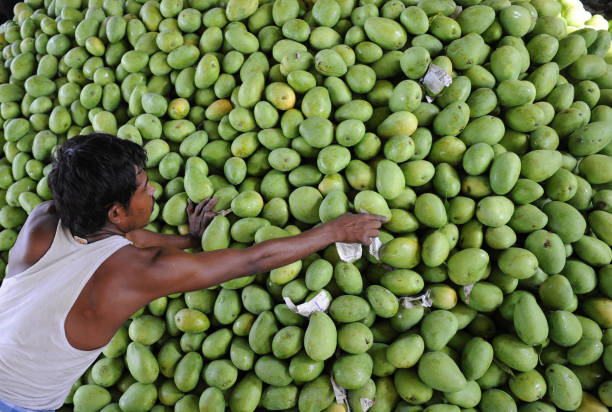
Even in good years, farmers consider mangoes one of the hardest fruit crops to cultivate. They depend on a delicate balance of climate, tree physiology, and farming techniques. Achieving that balance is vital for India, the world’s largest mango producer, which harvests 23 million tonnes each year—nearly a fifth of the country’s total fruit output.
For many growers, mango cultivation has become increasingly unpredictable. Upendra Singh farms 16 acres in Malihabad, Uttar Pradesh, and has worked the family orchard since he was 12. Now 62, he says, “Seasons no longer follow a pattern. Flowering, fruiting, and harvesting shift every year because of climate change.” Costs for pesticides, labour, and irrigation keep rising, yet yields decline. Farmers spend more but earn less from mango orchards.
The Diversity of Indian Mangoes
India cultivates almost 700 mango varieties, each region favouring its own. Northern India grows mostly Dasheri, Maharashtra produces Alphonso, and Bihar and West Bengal favour Langra and Malda. Despite regional variety, few farmers escape climate pressures. Dr Hari Shankar Singh of the Central Institute for Subtropical Horticulture explains, “Mango is highly temperature-dependent. Last year, early flowering, strong winds, and rapid maturity caused massive losses. This year, prolonged cold delayed flowering in northern India.”
To help farmers adapt, researchers develop mango varieties that tolerate wider temperature ranges and resist pests and disease. Progress is slow because trees take five to ten years to flower after breeding. Mangoes also remain heterozygous, so offspring rarely resemble parent trees. Hari Singh says, “Mango breeding requires decades of work. It is not a quick innovation.”
Genetic Science Accelerates Breeding
Genetic research has sped up the process. ICAR scientists sequenced the mango genome in 2016, focusing on Alphonso. Genome sequencing identifies genes controlling fruit colour, aroma, sweetness, flowering, climate resilience, and disease tolerance. This breakthrough reduces breeding time from 10–20 years to significantly less, allowing farmers to benefit from new varieties faster.
Farmers eagerly adopt innovation. Upendra Singh planted a coloured mango variety in denser rows than his old orchard. “Coloured varieties give fruit every year. Traditional Dasheri and Langra often have off years,” he explains. Modern techniques improve yields further. Scientific pruning, canopy management, and growth regulators help control tree size, induce flowering, and achieve uniform harvests.
Practical Techniques for Better Yields
ICAR promotes practical innovations. “Bagging” protects each fruit with a breathable cover during early growth, reducing pests, fungal disease, mechanical damage, and sunburn, says Dr T Damodaran, ICAR director. Another method, “girdling,” involves cutting a narrow ring on selected branches to redirect energy into flowering and fruiting. Older orchards benefit from rejuvenation by cutting trees to 14–18 feet, improving flowering, fruit size, and fruit grade.
Neeti Goel turned a hobby into large-scale mango farming. She now manages 1,100 trees on 27 acres in Alibhaug, Maharashtra. She says, “We start each season with soil and leaf analysis. Fertiliser without analysis is guesswork. Micronutrients like boron and zinc determine fruit quality and yield.” She plans to move trees into greenhouses for controlled temperatures, warning that ignoring innovation threatens survival.
Export Challenges and Greenhouse Solutions
Saravanan Achari, founder of Berrydale Foods, exports Indian mangoes to 13 countries. Pests pose major risks because even one fruit fly can destroy an entire shipment. Climate change worsens this problem by making rainfall and pest cycles unpredictable. Achari says, “Climate change is the single biggest risk to mango exports.” To address this, he experiments with greenhouses. Countries such as Japan and Israel use protected cultivation to overcome similar challenges. Indian farmers may need to follow suit to secure consistent quality and reliable exports.
