


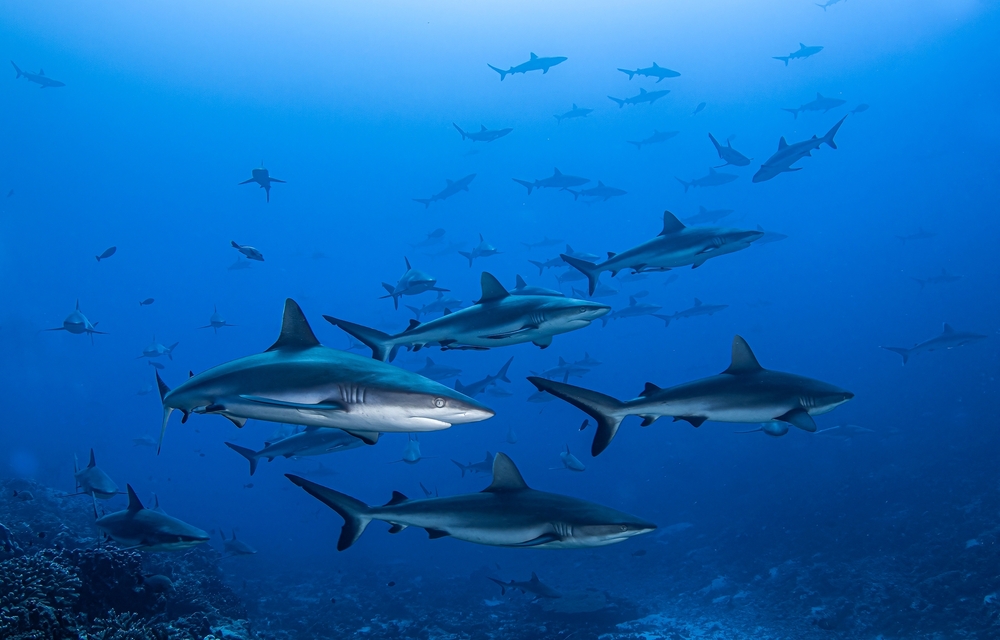
Hidden peaks beneath the waves
Under the rolling ocean surface rise vast chains of subsea mountains that teem with sharks. Ocean currents rush over these extinct volcanoes and shape a dramatic underwater world. These seamounts rise sharply from the seafloor and reach heights of more than 1,000m. Some hold deep craters or jagged ridges. Others form broad plateaus. A few even push above the surface and create islands.
Borderlands rich with life
Seamounts act as borderlands where reef species meet open-ocean life. Every level of the food chain thrives there, from tiny plankton eaters to powerful predators. Each seamount hosts a unique community filled with corals, sponges, crustaceans, fish, sea stars, whales, turtles, dolphins, sharks and many more creatures. These peaks support far more species than the flat seafloor. Many of these species live nowhere else. Scientists expect to find countless more.
A world of 100,000 underwater mountains
Experts believe the planet holds more than 100,000 seamounts spread from the icy North Atlantic to the deep Pacific. Fewer than 0.1% have been explored. Ali Mashayek, associate professor of climate dynamics at the University of Cambridge, says scientists have found an extraordinary number of volcanic seamounts during recent decades. Ongoing expeditions reveal more every year. One recent Atlantic mission even uncovered an unusually high number of top predators.
Life at Ascension Island
Sam Weber worked for seven years as the principal conservation scientist on Ascension Island. He describes the experience as life in a small remote village with familiar faces, quiet routines and excellent beaches. Ascension sits as a tiny green dot between Africa and Brazil. Yet the waters around it reveal a hidden world shaped by a vast undersea volcano.
A chain stretching across the Atlantic
Ascension marks the summit of a volcano that broke the surface and became an island. It belongs to a long chain of seamounts stretching hundreds of miles through St Helena towards Africa. Weber, now a lecturer in marine vertebrate ecology at the University of Exeter, explored three seamounts located about 300km from Ascension.
