


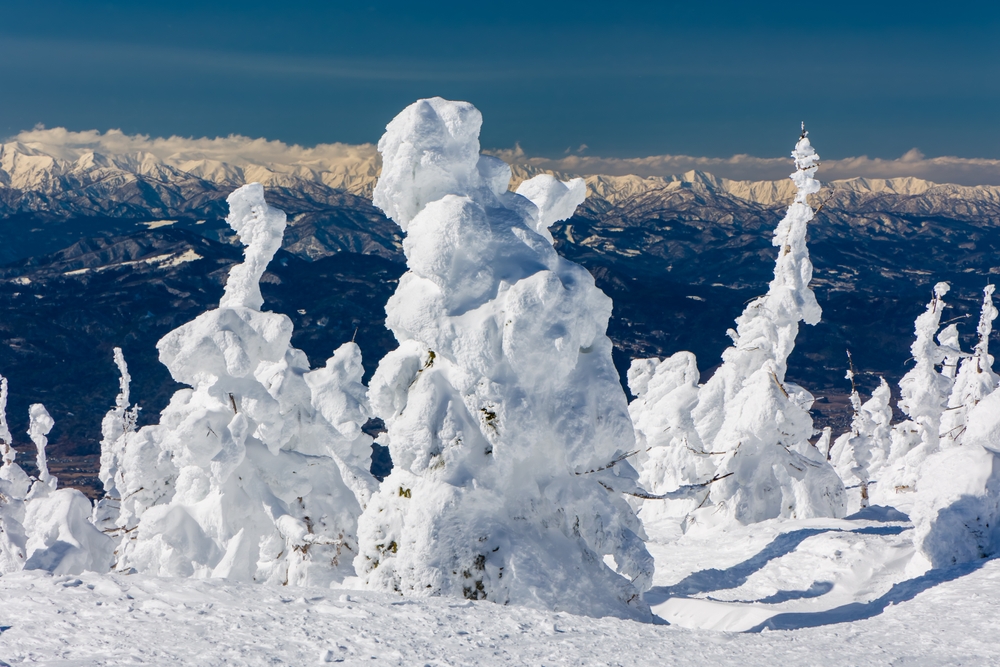
A unique natural wonder faces decline. Japan races to protect its breathtaking “juhyo” before they vanish.
Ghostly Trees Transform the Winter Landscape
Every winter, Mount Zao’s upper slopes in northern Japan, a top ski destination, change dramatically. Fir trees coat themselves in thick frost and snow, swelling into ghostly figures called “juhyo” or snow monsters.
Juhyo emerge only under exceptionally rare conditions. Strong, persistent winter winds carry supercooled water droplets that freeze on Aomori todomatsu trees. Layer by layer, rime ice forms, shaping the iconic figures.
At Mount Zao, these formations appear when westerly winds reach 26 meters per second and surface temperatures drop between -6.3°C and -0.1°C. High cloud water content adds to the effect. Ice accumulates on the windward side of trees, forming overlapping ridges called “shrimp tails.” Together, these ridges create the towering snow monsters.
“Zao’s snow monsters are almost unique to northern Japan,” says Fumitaka Yanagisawa, emeritus professor of geochemistry at Yamagata University.
A Winter Attraction Under Threat
The snow monsters attract tens of thousands of visitors every year. Zao, straddling Yamagata and Miyagi prefectures, depends on their winter spectacle.
Recent research, however, signals trouble. In August 2025, Yanagisawa’s team analyzed summit photos dating back to 1933, measuring figure thickness on a six-point scale. They found a clear decline in size over decades.
“Juhyo once measured five to six meters across in the 1930s,” Yanagisawa says. “By the postwar decades, they shrank to two to three meters. Since 2019, many are just half a meter or less.” Some barely resemble columns.
Climate Change and Forest Decline
Yanagisawa identifies two main threats: a warming climate and forest damage. In 2013, moth outbreaks stripped Aomori todomatsu needles, followed by bark beetles in 2015. Yamagata reports 23,000 firs dead, about a fifth of the prefectural stands. Fewer needles mean less ice can cling.
Another 2019 study in Yamagata City shows December-to-March temperatures rose two degrees Celsius over 120 years. The lower altitude limit for juhyo has climbed, while the seasonal duration shortened.
“Unique landscapes are disappearing due to climate change,” warns Akihiko Ito, ecologist at the University of Tokyo. Rising temperatures and extreme weather harm Japan’s high mountain forests, disrupt seasonal patterns, and expand insect outbreaks.
A Race Against Time
Alpine zones across Japan warm faster than the global average. Ito cautions that, in warmer-than-usual winters, juhyo may stop forming entirely by century’s end.
Yamagata officials have launched proactive measures. In March 2023, the prefecture established the Juhyo Revival Conference. Researchers, officials, businesses, and residents coordinate efforts to restore fir forests and preserve snow monsters.
Juhyo also support the local economy. Genji Akiba, deputy director of the Zao Onsen Tourism Association, emphasizes the importance of tourists for hotels, restaurants, and shops. “If the juhyo disappear, the impact would be huge.”
Conserving Fir Trees for Future Generations
Local conservationists act with patience and care. Since 2019, Yamagata’s forest office transplanted over 190 naturally regenerated saplings from lower slopes to the summit near the ropeway. Firs take 50 to 70 years to mature, requiring sustained efforts across generations.
Students from Murayama Technical High School participate in the revival. Since 2022, they plant Aomori todomatsu, propagate seedlings, and experiment with artificial methods. They collect saplings on Mount Zao and grow them at school, learning to protect and sustain the species.
“It has been challenging,” says Rin Oizumi, a second-year student. “Watching sprouts finally appear brings joy, but mice sometimes destroy them.” Classmate Kanon Taniai recalls seeing more fallen trees near the summit in July 2024. “It made me feel really sad. We want to help Mount Zao recover.”
Preserving a Legacy for the World
For Taniai, protecting juhyo means passing their legacy to future generations. “They are called snow monsters because nothing else looks like them,” she says. “I want the world to see them and appreciate Japan’s unique nature.”
Mount Zao’s snow monsters remain a fragile but iconic symbol. With sustained effort, research, and community dedication, Japan hopes to restore this rare winter spectacle for generations to come.
