


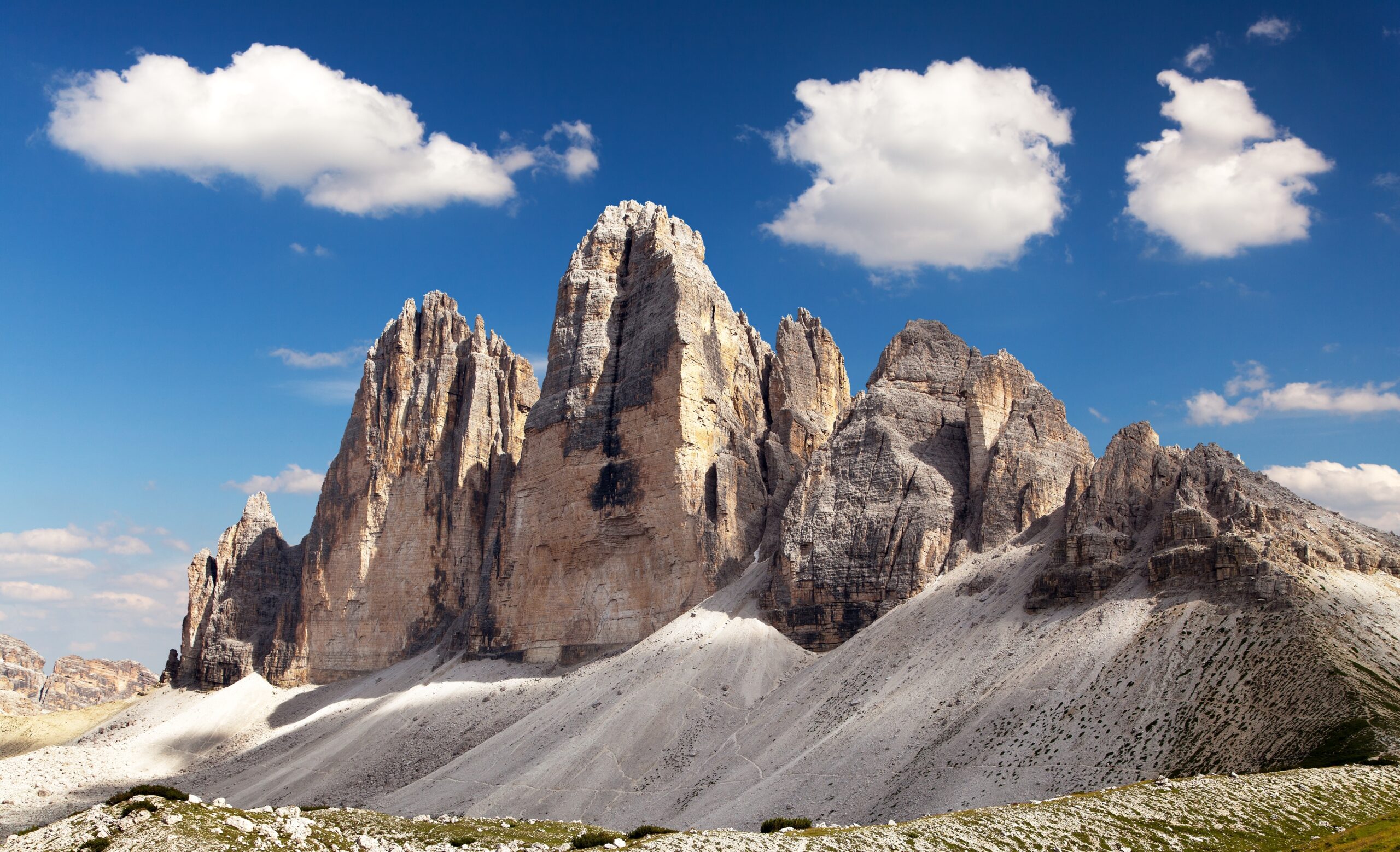
When one of Italy’s beloved Five Towers collapsed, experts initially called it rare. In reality, peaks across the Dolomites are constantly crumbling.
The Five Towers – an iconic cluster in the Eastern Italian Alps – resembled five stone fingers pointing skyward. Between 4 and 7 June 2004, the Trephor Tower toppled. Rifugio Scoiattoli, a nearby chalet, had not yet opened for the summer, so no one witnessed the collapse. One morning, visitors saw the Trephor, a 10,000-cubic-metre monolith, lying horizontally. Its size matched the leaning Tower of Pisa without bells or crowds.
Antonio Galgaro, associate professor of geosciences at the University of Padua, believes he can predict the next collapse. “It’s like a panettone divided into slices. This one will detach and rotate until it falls,” he says, pointing to a peak on an aerial photograph. The English Tower already displays a diagonal crack, signaling imminent failure.
Throughout summer 2025, landslides have repeatedly blocked roads in the region set to host the next Winter Olympics. On 15 June, local resident Francesco Accardo saw “rocks as big as cars bouncing down Mount Antelao’s ravine.”
Just two hours from Venice, the Dolomites form a UNESCO Natural Heritage Site. Italians and visitors alike admire its beauty. After spending childhood holidays there, I now wonder if the entire range might eventually collapse. If so, can humans intervene?
How the panettone comes down
The Trephor fall was not an isolated incident. Since then, numerous collapses have occurred: Grand Vernel (2015), Piccola Croda Rossa (2015, 2016), Cima Lastei (2016), Carè Alto (2018), Croda Marcora (2021, 2025), and Sassolungo and Cima Tosa (2023). Videos show mountains shedding massive chunks, pinnacles toppling, and debris flowing like rocky rivers.
Falling is intrinsic to the Dolomites. These peaks originated as tropical ocean atolls. The collision of European and African tectonic plates pushed them upward hundreds of millions of years ago. Beneath dolomia stone lies soft clay. “It has the consistency of Das,” says Galgaro, comparing it to a malleable grey terracotta.
Guides notice the terrain feels fragile. Giovanni Crosta, a geology professor at Milan-Bicocca University, explains that rock monoliths tilt and rotate on the clay. From above, towers appear slightly inclined outward. One side sinks, forming a diagonal crack. Gravity then pulls the rock down. “The DNA of every mountain is to come down,” Crosta says. Large rockfalls created the Dolomites’ jagged spires and gravelly slopes.
Belluno province alone has recorded 6,133 significant landslides since the Middle Ages. Many events likely went unrecorded. Scientists cannot determine whether rockfalls are accelerating. Locals, however, sense growing instability, partially due to media attention ahead of the 2026 Winter Olympics. Crosta notes, “You feel like you are walking on something more fragile than before.”
The radiator effect
Researchers link landslides to triggers such as heavy rainfall. “Intense short rainfalls have increased concerningly,” says Eleonora Dallan, assistant professor at the University of Padua. Extreme events have become more frequent, with maximum precipitation rising 5–20% over the past 30–40 years.
Water enters cracks, freezes, and expands, fracturing rock. Francesco Comiti, associate professor at the University of Padua, notes the freeze-thaw cycle has accelerated recently. Galgaro adds, “Fracturing accelerates heating and cooling, measurable with infrared cameras.” These observations help gauge which rock masses are vulnerable.
Galgaro compares fractured rock to a radiator: separated elements warm and cool faster than a single block, increasing collapse risk. Shorter peaks without permafrost, like many Dolomites mountains, lack frozen “glue,” making them more unstable. Falkner Peak, at 2,999 meters, collapsed on 27 July and 1 August 2025. About 300,000–400,000 cubic meters of rock fell.
Though landslides have occurred for centuries, unpredictability and frequency now pose major concerns. Forecast models that guided construction for generations no longer apply. Crosta asks, “Should paths be moved 50–100 meters to remain safe?”
Living with falling rock
Galgaro uses an Italian metaphor: “the patch is worse than the hole,” warning against interventions that could worsen the problem. “Nature can only be accompanied,” he says. “You cannot oppose it; nature always wins.”
Eni village, built in the 1950s near Mount Antelao, lies in the path of debris. Rockfalls from the mountain claimed two lives in Cancia. Scientists now focus on monitoring and alert systems. Galgaro’s team converts mountain vibrations into audible sounds, like a candy wrapper seconds before a collapse.
Crosta’s team observes a thin 80-meter spire in the Pisciadu. Half of the monolith fell in 2018. The remaining blade sits on a sensitive foundation. Italy’s Institute for Environmental Protection and Research maintains a landslide database to inform residents and buyers.
Even heavily engineered sites like Mont Blanc’s Goûter Route face uncontrollable rockfalls. Officials now prioritize timing, opening cableways early for climbers when conditions are safer. The goal is not to stop rockfalls, but to live with the risk.
Alpine guide Enrico Maioni has climbed the Dolomites for 51 years. “I know my limits, but a collapsing wall leaves little chance,” he says. Passion drives him despite the danger.
Finding hope in change
Erosion can reveal unexpected wonders. A year ago, ancient glaciers emerged under Mountain Pelmo’s debris. The Five Towers originally had 12 peaks, so losing one is not unprecedented. Crosta emphasizes that the Dolomites are a natural World Heritage Site. Nature evolves, and preserving static forms would be nonsensical.
Some changes reflect human impact, but reversing them would require altering all human activity. Instead, residents, scientists, and visitors learn to appreciate these mountains while respecting their dynamic nature.
